
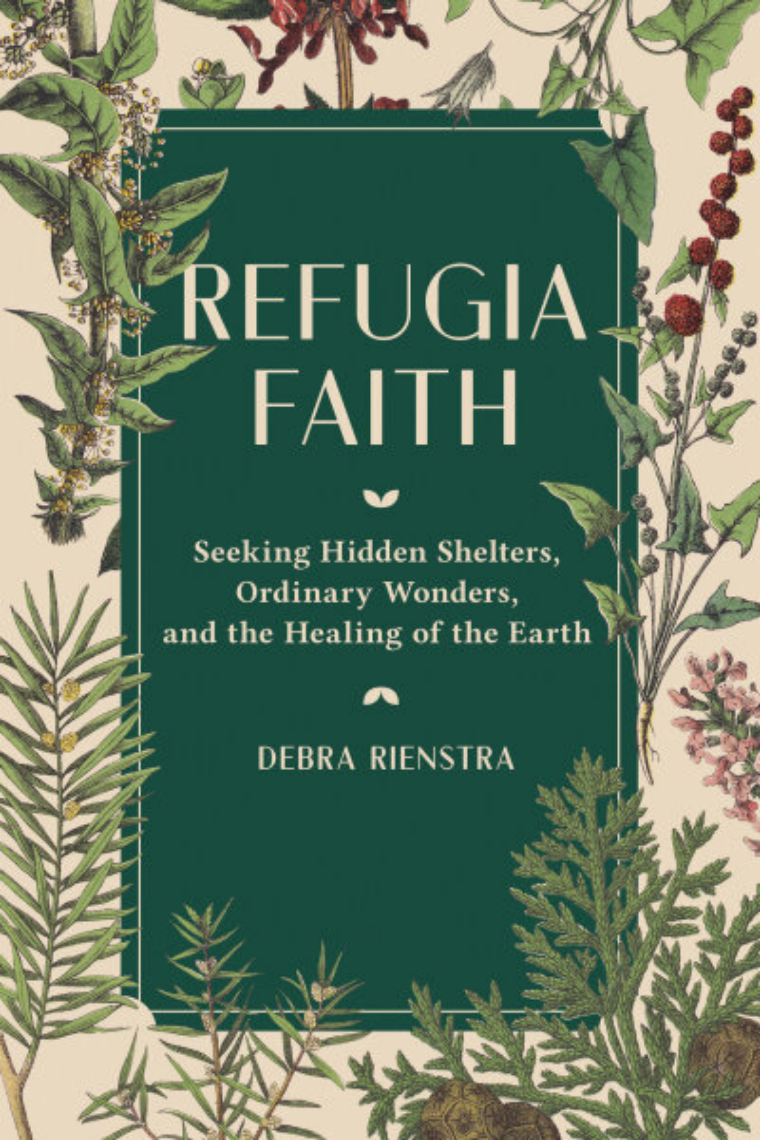
Refugia Faith
Seeking Hidden Shelters, Ordinary Wonders, and the Healing of the Earth
Debra Rienstra
Released: Feb 22, 2022
Publisher: Fortress Press
Retail Price: $23.99
Length: 216 pages
Binding: Hardcover
ISBN: 9781506473796
Refugia Faith: Seeking Hidden Shelters, Ordinary Wonders, and the Healing of the Earth explores how Christian spirituality and practice must adapt to prepare for life on a climate-altered planet.
Refugia (reh-FEW-jee-ah) is a biological term describing places of shelter where life endures in times of crisis, such as a volcanic eruption, fire, or stressed climate. Ideally, these refugia endure, expand, and connect so that new life emerges.
Debra Rienstra applies this concept to human culture and faith, asking, In this era of ecological devastation, how can Christians become people of refugia? How can we find and nurture these refugia, not only in the biomes of the earth, but in our human cultural systems and in our spiritual lives? How can we apply all our love and creativity to this task as never before?
Rienstra recounts her own process of reeducation–beginning not as a scientist or an outdoors enthusiast but by examining the wisdom of theologians and philosophers, farmers and nature writers, scientists and activists, and especially people on the margins.
By weaving nature writing, personal narrative, and theological reflection, Rienstra grapples honestly with her own fears and longings and points toward a way forward–a way to transform Christian spirituality and practice, become a healer on a damaged earth, and inspire others to do the same.
Refugia Faith speaks to people securely within the faith as well as to those on the edge, providing a suitable entry for those who sense that this era of upheaval requires a transformed faith but who don’t quite know where to begin.
Endorsements
Discussion Guide
A good reading group can serve as a small refugium space. So I hope you will let this discussion guide enrich your experience of reading the book with a group of friends, a church group, a book group, or some other gathering of people where there is shared trust, a willingness to be challenged, and some joy.
Resources
Click the plus/minus buttons to see of my favorite resources in each category. These lists are dynamic! If you notice something missing, just let me know–I’m always adding things.
How to Find Joy in Climate Action: TED Talk with Ayana Elizabeth Johnson (2022)
Marine biologist and policy expert Ayana Elizabeth Johnson goes beyond the usual answers to the question “what can I do” and offers advice about finding a joyful way forward.
How to Visualize Climate Change: Basic Analogies with Climate Adam and Katharine Hayhoe (2024)
A great video to explain climate basics through several good analogies. Climate Adam (Dr. Adam Levy) and Dr. Katharine Hayhoe are climate scientists with a gift for communicating accurate information in winsome ways. A charming and funny introduction to the very, very basics.
Is There Any Good News about Climate Change? with Simon Clark (2024)
Atmospheric physicist and climate communicator Simon Clark explains that while we have not reached needed goals yet, we have made SO MUCH progress!
Here Comes the Sun by Bill McKibben (2025)
Everyone should read this book. The transition to clean energy is happening fast, but so many people still don’t understand what’s happening and why, especially in the US. McKibben brings the latest receipts. The two big takeaways: renewables are now cheaper than fossil fuels, and renewables by their nature end a world order in which petrostates and the fossil fuel industry hoard unbelievable power. Our job now is to speed up what’s already happening and reap the democratic benefits.
What If We Get It Right? by Ayana Elizabeth Johnson (2024)
A persuasive and invigorating book. Johnson tells the hard truth about climate change, then interviews dozens of incredible people at work in dozens of fields from agriculture to clean energy, all working toward a more just and sustainable global future. Johnson also hosts a fine podcast. A paperback will be released in 2026 with updated content.
Saving Us: A Climate Scientist’s Case for Hope and Healing in a Divided World by Katharine Hayhoe (2022)
Katherine Hayhoe is a world-renowned climate scientist, a Christian, and a consummate communicator. This indispensable book covers the facts about climate change, but it focuses on communicating wisely and effectively with others about the climate crisis. (See also Hayhoe’s TED Talk and YouTube channel.)
Katharine Hayhoe’s TED talk has been viewed more than 4 million times for good reason: it’s clear, persuasive, and inspiring. She brings the evidence to show that more people are worried about climate change than you might think, and yet we’re not talking about it. Here’s how to start talking well. (Everything she says is even more true today.)
IPCC AR6 Synthesis Report (2023)
The motherlode of facts, the summary of the global scientific consensus. The Intergovernmental Panel on Climate Change released this summary in March 2023. Read the Executive Summary for a helpful and readable introduction. This report summarizes the more extensive reports released earlier by the IPCC on the physical science of climate change, on impacts and the need for adaptation, and on mitigation strategies. The website also explains how these reports were created and by whom.
Volts Podcast with David Roberts
Longtime climate journalist David Roberts interviews people deep in the weeds figuring out the details for making the clean energy transition happen. This is a very wonky podcast, but it’s so good I listen to it regularly. Fascinating interviews with people working on grid transformation, battery tech, and all kinds of related challenges.
Excellent, reliable, non-profit news source. “Inside Climate News is a Pulitzer Prize-winning, nonprofit, nonpartisan news organization that provides essential reporting and analysis on climate change, energy and the environment, for the public and for decision makers.” ICN has several newsletters you can subscribe to, depending on how much news you can handle in a week.
The Crucial Years Newsletter by Bill McKibben
No one can match Bill McKibben for churning through all the climate news, summarizing it, This Substack newsletter provides in-depth weekly commentary about climate and climate action.
Climate Forward: The New York Times
An excellent weekly roundup of top climate stories reported in the New York Times. The NYT is still doing excellent climate reporting.
This is my newsletter on Substack (free!). I describe it as “A fortnightly newsletter for people of faith who care about the climate crisis and want to go deeper.” Climate news can be hard for people to follow, so I choose a couple top stories to summarize for you, providing links to go deeper. As I do this, I look for the ways that people of faith, especially Christians, are working in the climate movement. I also keep you updated on refugia news and offer links to good reading, listening, and watching.
The Weekly Anthropocene by Sam Matey-Coste
Matey-Coste is indefatigable as a climate writer. He covers global climate news, interviews change-makers, produces a LOT of content. Good place to go especially for encouraging conservation news.
Data scientist Hannah Ritchie makes the case–using loads of data on what is already happening–that we can create a livable, thriving future if we address the climate crisis head-on, strategically. This book is a good antidote to the doom spiral that can result from only reading climate headlines in the news.
IPCC Special Report: Global Warming of 1.5 ºC
This is the report that most famously sounded an urgent alarm call. The full report is formidable in length, but the executive summary is sufficient for a general reader.
Yale Program on Climate Change Communication
The YPCC’s mission is to increase public understanding of climate science. They research public opinion and knowledge about climate and provide educational materials. The Six Americas Survey has been an especially useful tool in understanding Americans’ views on climate change.
Project Drawdown (book and website)
“Project Drawdown is an independent, internationally trusted organization driving meaningful climate action by connecting people like you to science-based climate solutions and strategies.” A great site to explore when you wonder how the transition can possibly happen. Among other things, the group researches what each solution will cost and what it will save.
Global Weirding with Katharine Hayhoe (YouTube Channel)
The place to go for answers to commonly asked questions about climate. Dozens of short, pithy videos explain complex matters in simple terms. Excellent place to get your own questions answered and to prepare for talking to people who are misinformed or unsure.
Entangled Life: How Fungi Make Our Worlds, Change Our Minds & Shape Our Futures by Merlin Sheldrake (2021)
After reading this fascinating book, you too will understand that fungi 1) are really cool and 2) rule the world.
An Immense World: How Animal Senses Reveal the Hidden Realms Around Us by Ed Yong (2023)
Page after page of awe-inspiring descriptions of animals’ astonishing abilities to experience the world differently than humans, based on the latest research. I recommend the audio book, which Yong himself reads masterfully.
Underland: A Deep Time Journey by Robert Macfarlane (2020)
Splendid, fascinating explorations of the earth’s under-the-surface mysteries. Macfarlane recounts adventures in caves, glacial crevices, underground rivers, underground labs, and more. Poetic and philosophical—could easily go in the literature section.
The Sixth Extinction: An Unnatural History by Elizabeth Kolbert (2014)
A readable and compelling account of what we know about species extinction and how we know it. Kolbert is a congenial master of the science writing genre.
Great Tide Rising: Towards Clarity and Moral Courage in a Time of Planetary Change (2016)
Moore, an academic philosopher, makes a persuasive case for the moral imperative to act in response to the climate crisis. Her beautiful nature writing is a bonus. This is the book where I first learned about the concept of refugia!
Becoming Animal: An Earthly Cosmology by David Abram (2011)
A poetic and philosophical exploration of the “elemental kinship between the human body and the breathing Earth.” I especially love the chapters on bird flight, with its rhapsodic account of a bird’s whole-body intelligence.
Kiss the Ground (film and website)
The original documentary (2020) on regenerative agriculture sparked a movement. The website now features all kinds of resources to learn more about rengerative agriculture and help persuade others, especially farmers and ranchers.
My Octopus Teacher (2020)
This lovely documentary (on Netflix) recounts the remarkable friendship between filmmaker Craig Forster and a little octopus he met off the coast of South Africa. (Dir. by Pippa Ehrlich and James Reed.)
The Story of Plastic (2019)
Produced by The Story of Stuff, this documentary makes for grim viewing. It describes the global plastic pollution crisis and exposes how the fossil fuel industry has manipulated public understanding in order to relieve the industry of responsibility and keep the profits churning. Crucial viewing for anyone who thinks the way to address the climate crisis is by recycling plastic. Alas, no.
Gorgeous literary essays on the themes of reciprocity and gratitude, blending indigenous and scientific wisdom. An absolute must-read. A bestseller for good reason.
The Overstory by Richard Powers (2019)
This unforgettable novel interweaves the stories of nine characters who get tangled up in eco-activism. But trees and forests are the real protagonists, irradiating the novel with their being-ness. Every sentence in this absorbing novel is a work of art.
Is a River Alive? by Robert Macfarlane (2025)
Somehow Macfarlane combines philosophical reflection with breathtaking adventure and splendid prose as he explores the being-ness of rivers as living ecosystems in Ecuador, India, and Canada.
Ministry for the Future by Kim Stanley Robinson (2020)
A “through-topia” imagining how we can get through the next few decades more or less intact. Robinson is known as a “non-fiction” novelist because he researches so thoroughly for his novels. You can’t be in climate spaces for long without talking about this novel.
The Lost Words: A Spell Book by Robert Macfarlane and Jackie Morris (2017)
A coffee table book pairing Macfarlane’s whimsical and muscular poems with ravishing art by Jackie Morris. Each “spell” celebrates the distinct delights of a particular creature or plant. Ideal gift for all ages, including young children.
The Lost Spells by Robert Macfarlane and Jackie Morris (2020)
A smaller cut-size book with yet more irresistibly beautiful poems and art.
The Lost Words: Spell Songs by Robert Macfarlane and Jackie Morris (2019)
UK folk musicians who loved Lost Words created this collection of songs based on the poems. The book includes interviews, more “spells,” and other supplementary delights. There’s a second album, too!
All Creation Waits: The Advent Mystery of New Beginnings by Gayle Boss (2016, gift edition 2022)
Ideal for reading with children (ages 6+) during Advent. Beautiful little essays about how different creatures spend the winter, with wise spiritual resonance for humans.
Wild Hope: Stories for Lent from the Vanishing by Gayle Boss (2020)
More gorgeous little essays, this time intended for reading during Lent. Also appropriate for children, but this book features animals at risk of extinction, so parental discretion advised.
Laudato si’: On Care for Our Common Home (2015)
By Pope Francis. Essential reading for any Christian and any person of faith and conscience. The pope’s encyclical is bold, prophetic, and uncompromising.
The Letter: A Message for Our Earth (2022)
A beautiful and inspiring documentary that makes the climate crisis real, as experienced by six ordinary people from around the world. In response to Laudato si’, the Vatican invited these six to represent the young, the poor, Indigenous peoples, and animals so that each of the six guests might speak on behalf of their communities and the earth. The film portrays these leaders’ work, their audience with Pope Francis, and their deep connection with one another.
Refugia Faith (2022)
Since you’re here, you know about this book already!
The Great Work: Our Way into the Future by Thomas Berry (1999)
A prophetic work by a Catholic “geologian” that still feels entirely relevant.
The Travail of Nature: The Ambiguous Ecological Promise of Christian Theology by H. Paul Santmire (1985)
An extremely useful, winsomely analytical survey of Christian theological reflection on the earth, emphasizing the mainstream “Western” tradition from Irenaeus to Barth.
Shalom and the Community of Creation: An Indigenous Vision by Randy Woodley (2012)
Woodley, a member of the United Keetoowah Band of Cherokee peoples, Jesus follower, and co-founder of Eloheh Indigenous Center for Earth Justice, finds the fruitful overlap between indigenous ways of living on the earth and what the Bible says about human relationship to the rest of creation.
Aimed at Christian laypeople and young adults, this series of essays draws from a range of academic disciplines to consider where the concept of “stewardship” may be inadequate and how to move beyond it.
The Christian Imagination: Theology and the Origins of Race by Willie James Jennings (2011)
A gorgeous, challenging work of scholarship. Jennings examines the beginning of European colonialism in the Americas to show how race is inextricably connected to land conquest and how religion was (and is) leveraged to justify colonialism, racism, and extractivism.
This category is impossible to cover because climate-action resources for faith communities proliferate daily—a good thing! In general, look first to your denomination (if applicable) and then to some of the orgs in the category above. These are just a few of my favorites. Also, these groups typically have their own resource pages, so what you see below is a resource hub of resource hubs. If you see something missing, let me know!
Green Lectionary Podcast, hosted by Derrick Weston
Produced by Creation Justice Ministries, this podcast gathers a rotating cast of preachers, biblical scholars, and theologians to discuss biblical passages with a creation justice lens. The goal is to provide preachers with ideas and directions for sermons. Terrific resource!
The brainchild of homiletician Dr. Leah Schade, the EcoPreacher resource hub gathers all kinds of resources, from cohort programs to books to sample sermons, thanks to partnership among Creation Justice Ministries, The BTS Center, and Lexington Theological Seminary (where Schade teaches). The EcoPreacher column on Patheos is another way into the initiative.
Refugia Podcast, hosted by Debra Rienstra (2021-2025)
For four seasons, I interviewed people from a variety of fields–biology, art, farming, theology, environmental history, community organization, and more–to talk about how the refugia concept might be meaningful for them. Seasons 3 and 4 emphasize the theme “refugia church,” with emphasis on Christian communities working hard toward climate justice. Available on many podcast platforms or my Substack, with transcripts at my website.
Yale Forum on Religion and Ecology
The site provides educational resources, news, events, and inspiration for people of all faiths who are concerned about the climate crisis. This one offers a more scholarly bent and a global perspective.
A coalition of faith communities supporting each other. They describe themselves as “a multi-faith campaign to strengthen vitality, relevance, and community connection across generations in local congregations nationwide.” They invite faith groups to “be part of a visible effort to invite creation care and climate action, no matter if you are just getting started or already engaging.”
A support hub for Catholic groups striving to follow the call of Laudato Si’ and work for climate justice. I especially admire their clear and excellent goals, applicable to any faith community.
Episcopal Church Creation Care
The Episcopalians have been on the job for a long time. Their ambitious new cohort model is called the Episcopal Path to Creation Justice.
The UCC has been on the job for a long time, too. They have a developed program, worth joining or learning from.
PC-USA Earth Care Congregations
Another great program encouraging churches to become “Certified Earth Care Congregations” and providing support for doing so.
Anabaptist Climate Collaborative
In many ways, Anabaptist folk have much to teach the rest of us about creation care and mindful living. This organization seeks “to equip and activate individuals, congregations, and organizations to seek climate justice through Anabaptist values, community, and faith.” They work across North America and the world. I especially love their youth leadership development initiatives.
Plenty of good things going on among the ELCA Lutherans. They have a church certification program, too, with resources and support available.
Disciples of Christ Green Chalice Certification Program
Yep, another program to inspire and support churches in their creation care work.
This organization helps faith communities spec and install solar. Their mission is to bring “technical expertise and client-friendly financing to simplify participation in a just, clean-energy transition for faith-based organizations. Our work prioritizes serving: Historically disadvantaged people, Low-income communities, People of all faiths.
Third Act Faith Resources page
You’ll see a lot of the same resources here, but there are additional ones, too, especially for Jewish, Muslim, Buddhist, Sikh, and other faiths.